
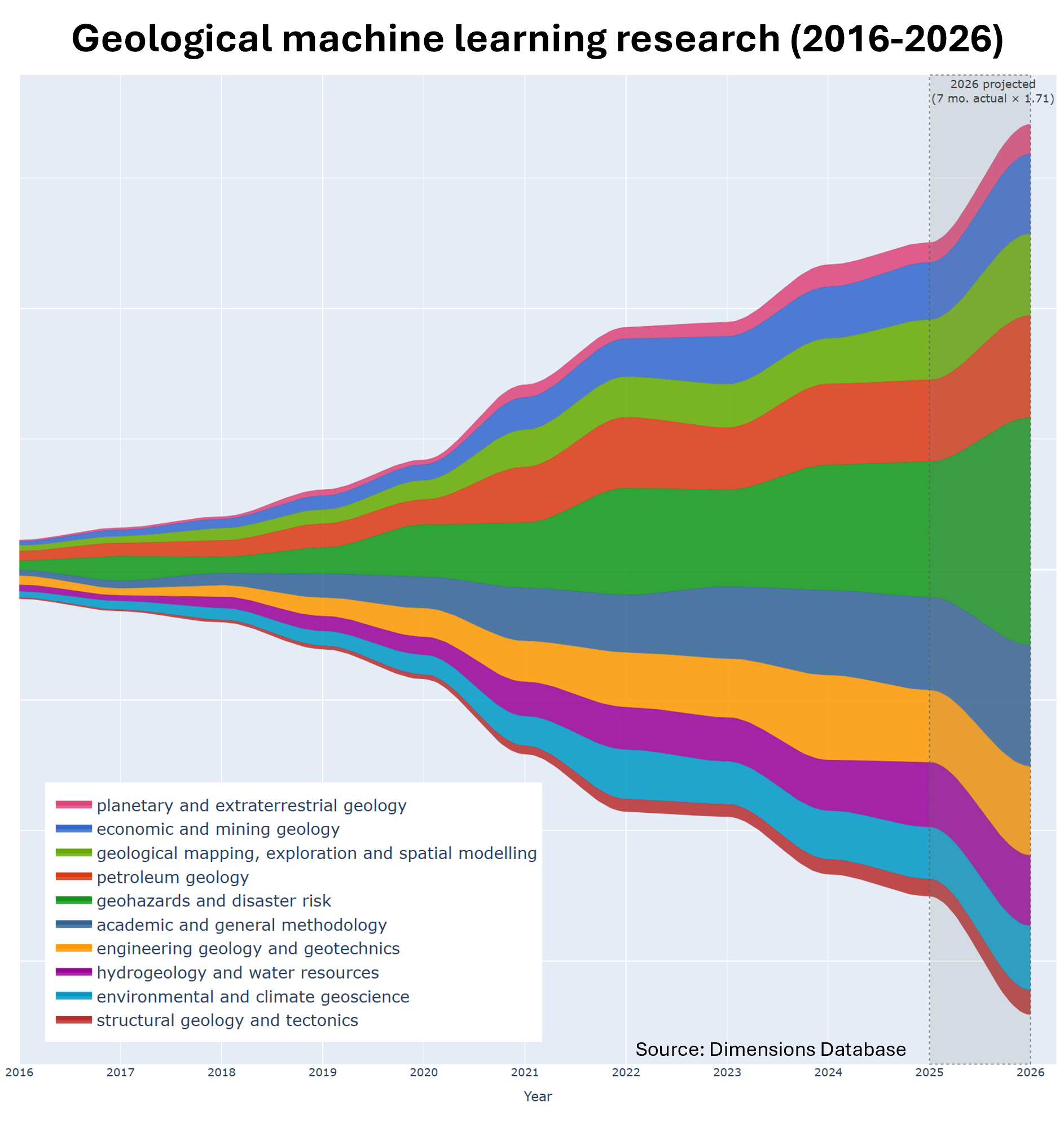
Geological machine learning global research past 10 years. Research on natural hazards and disaster risk is comfortably the largest category, followed by academic/methodological topics and petroleum geology, geological mapping and spatial modelling, engineering geology, followed by economic mining geology and hydrogeology, environmental and climate science, then structural geology & tectonics and planetary geology.
A significant increase in the volume of research papers was seen 2020-2021. It remains to be seen if 2026 also delivers a trend increase.
I used the Dimensions database to export all papers mentioning ‘geology’ and ‘machine learning’ in their abstract, title or keywords from 2016-2026. For ‘machine learning’ I included hyponyms (e.g. ‘deep learning’, ‘neural network’, ‘random forest’, ‘artificial intelligence’ etc.). These abstracts were classified to 10 geological categories using a zero shot embedding based (dense vectors) approach. Cosine similarity between each abstract embeddings was used to rank category relevance, the top k most similar categories were assigned per abstract. No labelling of fine tuning was used. I experimented with various categories to see what bias may be introduced, some of the broader trends (e.g. dominance of geohazards) held regardless of category naming.
For 2026, the actual data is to the end of July 2026, this has been linearly extrapolated to year end to include 2026 data without introducing a visual artefact due to partial data. It is possible that the first quarter is front loaded due to delays in publishing from the previous year, so a linear extrapolation may not be appropriate. This will be revisited with the actual data at year end.
I’m producing some t-SNE embedding plots and animations to examine the data from other angles which I will post shortly.
 A Geodyssey - Geoscience Text Analytics and Enterprise Search Research
Leave a comment