
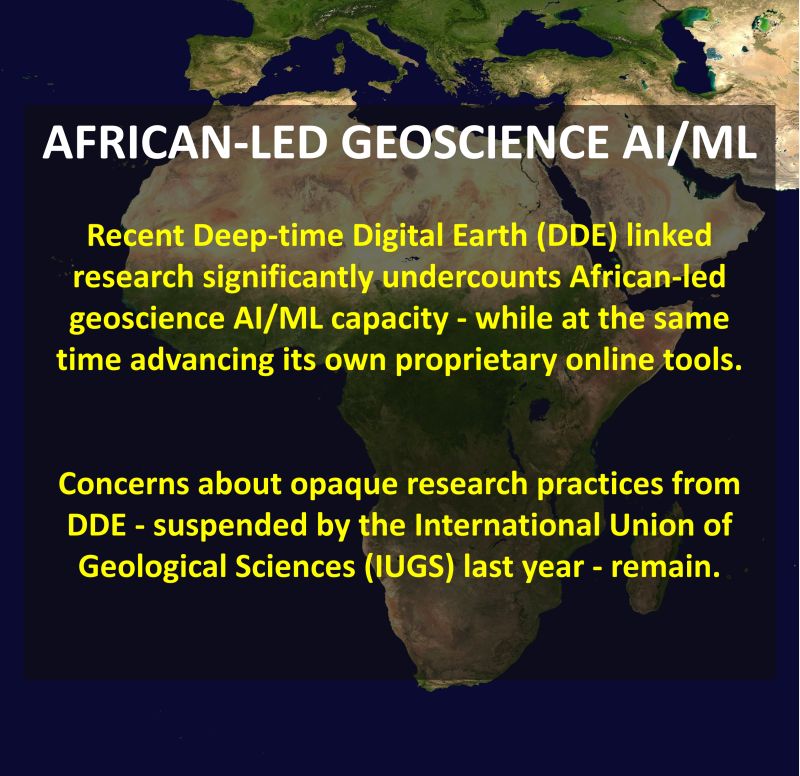
My peer-reviewed critique in Geoenergy finds that African-led geoscience AI/ML capacity is significantly under-counted in research linked to the Deep-time Digital Earth (DDE) initiative.
The DDE-linked paper identifies just 8 African-led geoscience AI/ML publications in 2024. Using comparable bibliometric methods based on just title/abstract screening, I identify 150+ publications across 22 African countries over the same period, following the original study design.
This discrepancy highlights a key issue: baseline construction in bibliometrics is not neutral.
Different methodological choices can produce very different representations of the same research landscape. This underscores the importance of transparency in how datasets are constructed, clear communication of limitations, and disclosure of analytical assumptions, especially when absolute publication counts are used to specifically support policy claims.
The DDE-linked research did not make transparent its methods, limitations, funding or competing interests.
An estimate of “8 papers” implies near-absence of capacity and can support narratives of external provision. Notably, the DDE-linked paper advances its own AI-enabled online platform as a central example for capacity building in the same paper. In contrast, “150+ papers” indicates a growing and geographically distributed research base, better aligned with partnership and capacity-leveraging approaches involving existing African AI/ML centres. These baselines are not technical details, they shape policy, funding priorities, and models of collaboration.
African research capacity remains underrepresented, but it is not absent. Bibliometric outputs are always conditional on what is being measured, they can represent either a conservative lower bound or a more inclusive upper bound depending on indexing and filtering choices. If these choices are not communicated explicitly, the resulting numbers can be easily misinterpreted.
The critique, dataset (150+ African-led AI/ML papers), and authors’ reply are linked in the comments. I also raise discussion points on concerns of geopolitical bias and African data sovereignty in the papers from the authors, which they remain silent on.
I encourage you to read the original papers, my critique, their reply and come to your own judgements.
https://www.lyellcollection.org/doi/full/10.1144/geoenergy2025-060
(scroll to the bottom of the page and click download PDF)
 A Geodyssey - Geoscience Text Analytics and Enterprise Search Research
Leave a comment