
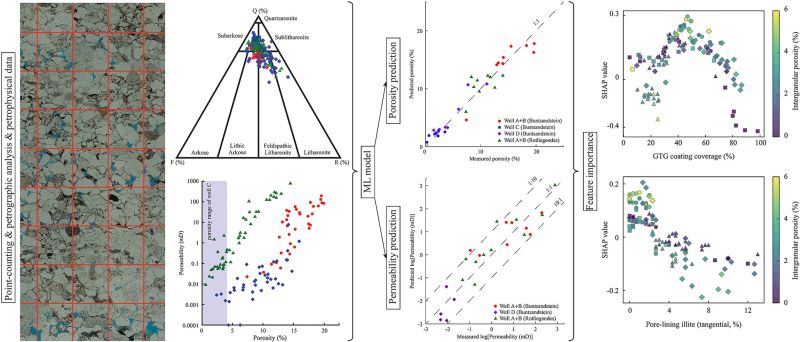
Porosity and permeability prediction from petrographic point-counting data using machine learning. A new study from the Karlsruhe Institute of Technology has demonstrated that machine learning can accurately predict porosity and permeability in reservoirs using microscopic rock descriptions from samples.
The researchers (Sadrikhanloo et al., 2026) trained models on petrographic point-counting data, mineral-by-mineral descriptions of rock composition that geoscientists have been routinely collecting for decades but rarely using for predictive modelling.
Large archives of legacy petrographic data, accumulated by the oil and gas industry over many decades, could be re-analysed to generate new reservoir insights at minimal cost. As geothermal energy and underground gas storage grow in importance, these techniques could provide a valuable approach. The study is a proof of concept with a limited dataset, and blind-well validation remains the essential next step.
This machine learning approach may simultaneously unlock another understanding of reservoir quality controls based on SHapley Additive exPlanations (SHAP) value plots. Further training of such models on cored reservoir sections can improve understanding of which detrital and authigenic mineral phases influence reservoir properties. Trained models could also potentially evaluate reservoir properties from cuttings, which, like well logs, are more continuous than cores while allowing diagenetic interpretation based on petrographic analysis.
Paper here: https://www.sciencedirect.com/science/article/pii/S266675922600020X
 A Geodyssey - Geoscience Text Analytics and Enterprise Search Research
Leave a comment