
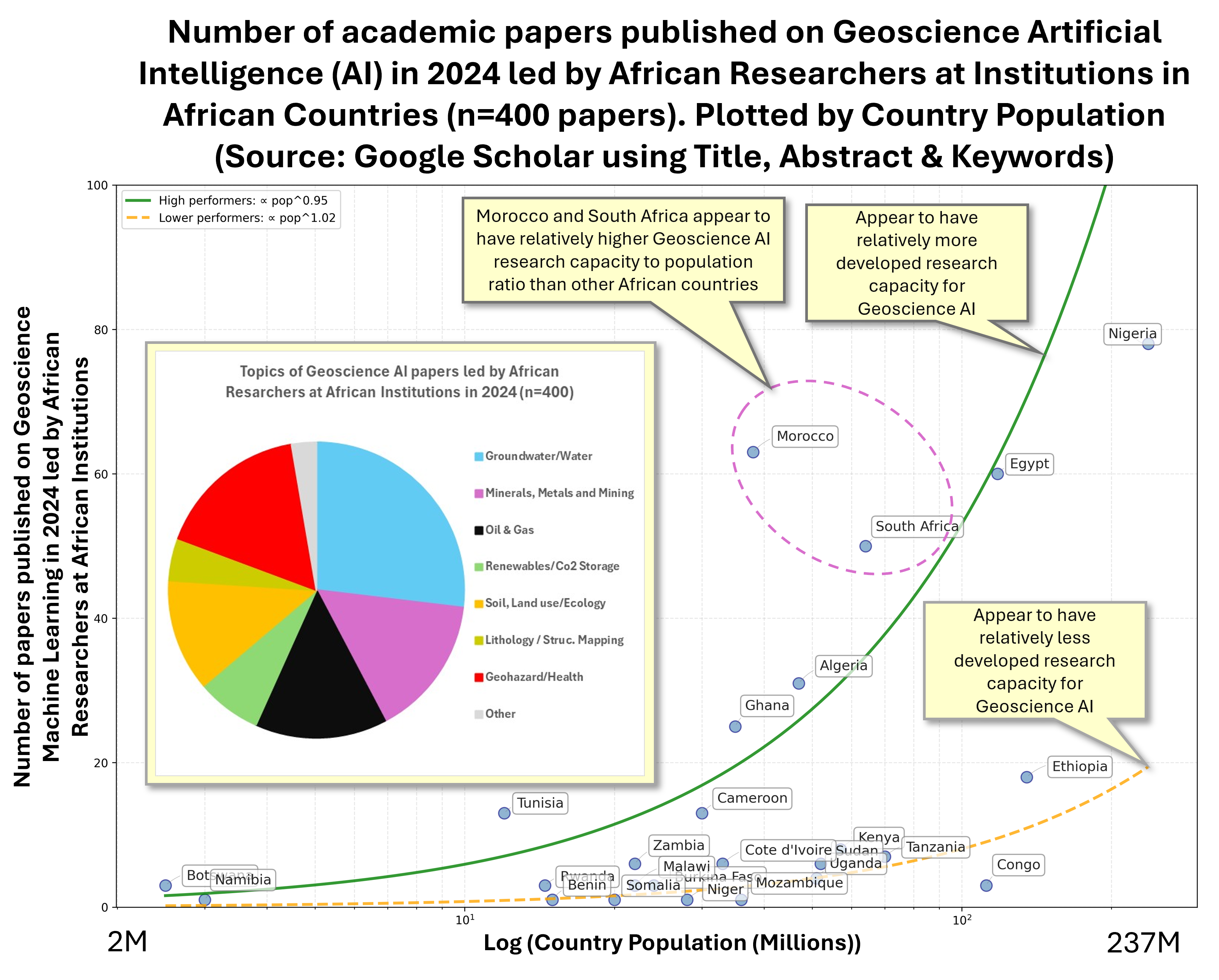
It was reported in a recent academic article there were only 8 published papers on Geoscience AI led by African institutions in 2024. My research shows 400+ papers led by African researchers at African institutions in 2024 on Geoscience AI. This is a non trivial discrepancy illustrating how bibliometric data is not neutral.
Reducing the complexity of research for an entire continent to a single number is unlikely to offer robust insights. With this in mind I have dug a little deeper to see what the data might reveal.
The published research paper count by country (authors institution) is on the y-axis, the country’s population is on the x-axis (Log from the UN/Worldometer). This shows the range in populations (2.5 Million to >230 Million which has to be taken into count when looking at overall capacity).
Methodology and Source: Using Google Scholar but looking only at titles, abstracts, keywords mentioning AI topics and Geoscience. If you only looked for the keyword “Artificial Intelligence” you would miss most papers.
In this context, “geoscience” is used in a rather restricted sense, centred on geology, geochemistry and geophysics, while also encompassing applied aspects related to hydrology, geometallurgy, geotechnical etc. I tended to exclude AI papers on oceanography, meteorology, climatology, atmospheric science and social-science applications of remote sensing. MSc and PhD dissertations were not included. Not all papers will be peer reviewed but most are, and casting a wide net mitigates against some common indices which undercount African research output.
The topics of water, mining, oil & gas and geohazards are the top 4 categories for geoscience AI papers from African institutions. The charts shows Africa may be split into two tiers regarding geoscience AI publishing capacity by population. Due to water supply, oil & gas and mineral wealth, geohazards and food production/land use, it is likely Geoscience AI is strategically relevant to all countries, with perhaps different emphasis in areas.
The data shows evidence for both extensive expertise in different aspects of geoscience AI as well as underrepresentation. I’ll do the same for 2025 in the New Year and compare, as well as releasing the bibliometric data on the papers, authors and institutions.
On another note, working with Andrew Lator in Zimbabwe, Natalie Brand in South Africa , Lawrence Omari-Mensah FWAIMM, FGS, MAIG in Ghana and Lovemore Machiridza and others we put on an extremely well attended webinar on Geoscience AI a few months ago, and have plans for more events in 2026.
 A Geodyssey - Geoscience Text Analytics and Enterprise Search Research
Leave a comment