
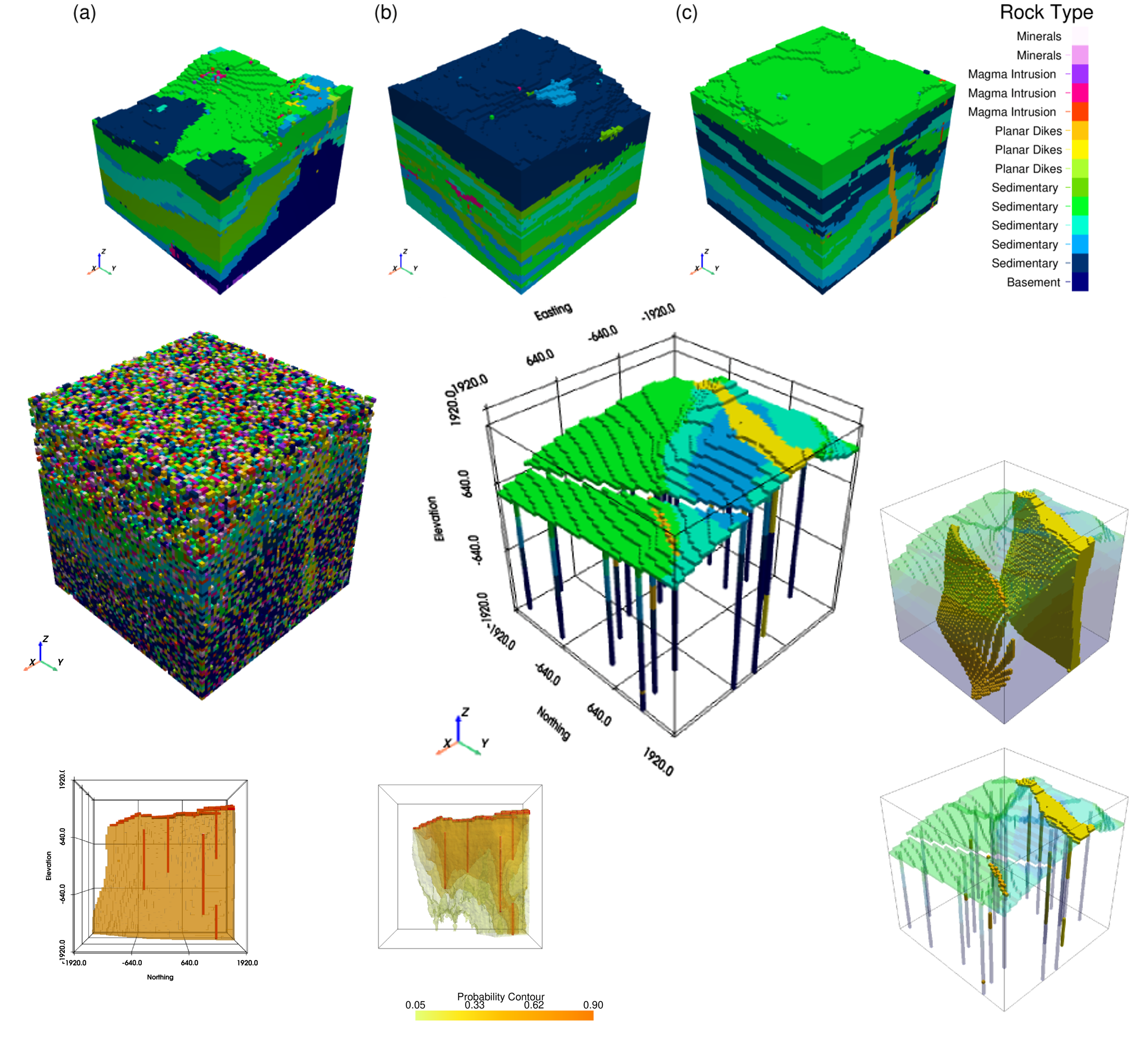
Synthetic Geology – Structural Geology Meets Deep Learning. Intriguing paper from Ghyselincks et al (2025). Subsurface deep learning by a synthetic data-generator process that mimics geological activity such as sediment compaction, volcanic intrusion, and tectonic. The authors then built a foundation model trained on this synthetic data to generate a 3D image of the subsurface from a previously unseen map of surface topography and geology depicting such structures as layers, faults, folds, dikes, and sills.
“Current open-source 3D modeling efforts have been led by tools such as GemPy, Noddy, and LoopStructural, producing 3D geological volumes using a set of informed and constrained parameters to model limited underlying geological processes over time. While these tools are invaluable in their respective scopes of use, they do not natively support large-scale randomization. For example, Jessell et al. have suggested that more parameters, more events, linked events, and more models would improve their existing efforts. We thus adopt a computational method suggested in Visible Geology, where geological processes are represented as mathematical transformations of a 3D mesh. By combining multiple transformations, one can generate a wide range of realistic geological models. In fact, such models are used to train geologists, suggesting their suitability as a synthetic dataset for training machine-learning models. Additionally, randomizing and reordering these processes enables the generation of a virtually limitless number of 3D volumes depicting complex and varied geology. We implement this randomized workflow in the open-source Python package StructuralGeo.”
“We illustrate the early promise of the combination of a synthetic lithospheric generator with a trained neural network model using generative flow matching. Ultimately, such models will be fine-tuned on data from applicable campaigns, such as mineral prospecting in a given region. Though useful in itself, a regionally fine-tuned models may be employed not as an end but as a means: as an AI-based regularizer in a more traditional inverse problem application, in which the objective function represents the mismatch of additional data with physical models with applications in resource exploration, hazard assessment, and geotechnical engineering.”
“Finally, while this study represents a significant step toward automation in structural geology, human expertise remains invaluable. Rather than replacing traditional geological interpretation, our approach should be viewed as a powerful tool that enhances geologists’ ability to explore multiple hypotheses, validate models, and make informed decisions in the face of uncertainty.”
 A Geodyssey - Geoscience Text Analytics and Enterprise Search Research
Leave a comment