
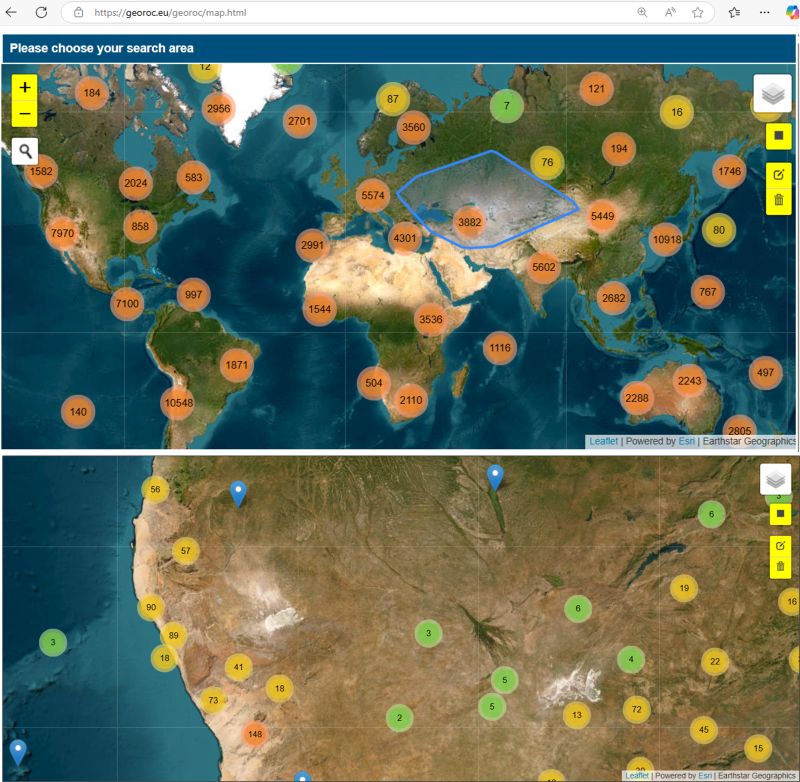
More rich open-source global geological data. GEOROC has over 39 Million data values, the largest geochemical database worldwide, a comprehensive collection of published analyses of igneous and metamorphic rocks and minerals. It was first established back in 1999.
The GEOROC Database (Geochemistry of Rocks of the Oceans and Continents) contains major and trace element concentrations, radiogenic and non-radiogenic isotope ratios as well as analytical ages for whole rocks, glasses, minerals and inclusions.
GEOROC data is from multiple geological settings including convergent margins, ocean islands, seamounts, oceanic plateaus, submarine ridges, ocean-basin flood basalts, continental flood basalts, archean cratons, greenstone belts, and intraplate and rift volcanics.
GEOROC provides FAIR (findable, accessible, interoperable and reusable) geochemical data, a data resource that supports and facilitates hundreds of new research publications each year across multiple geoscientific and related disciplines. Metadata include, among others, geographic location with latitude and longitude, rock class and rock type, alteration grade, analytical method, laboratory, reference materials and references.
Datasets in GEOROC are cross-linked with GeoReM, an MPI database for geological and environmental reference materials and is a key contributor and integral part of the EarthChem initiative. To date, GEOROC has been acknowledged in more than 3,000 peer-reviewed publications, many of which appeared in high-ranking journals.
GEOROC was first established by the Max-Planck Institute for Chemistry (MPIC) in Mainz, and is now hosted by Göttingen University as part of the Digital Geochemical Data Infrastructure (DIGIS) project of the Department of Geochemistry and Isotope Geology at the Geoscience Centre (GZG) and the University and State Library (SUB).
In a GEOROC paper back in 2015, the need was described to rescue “long tail data” in geochemistry, petrology, geochronology and marine geophysics by capturing these data in GEOROC. Long tail data defined as “data produced by individuals and small teams for specific projects, tending to be of small volume and initially for use only by these teams, thus being less likely to be easily transferred or reused. Long-tail data are at greater risk of omission from the scientific record.”
GEOROC V2.0 will see many improvements in the coming years. For more details see:
Klöcking, M. et al. (2023). Community recommendations for geochemical data, services and analytical capabilities in the 21st century. In Geochimica et Cosmochimica Acta (Vol. 351, pp. 192-205).
Prent, A. et al. (2023) Innovating and Networking Global Geochemical Data Resources Through OneGeochemistry. Elements 19, Issue 3, pp. 136-137.
 A Geodyssey - Geoscience Text Analytics and Enterprise Search Research
Leave a comment