
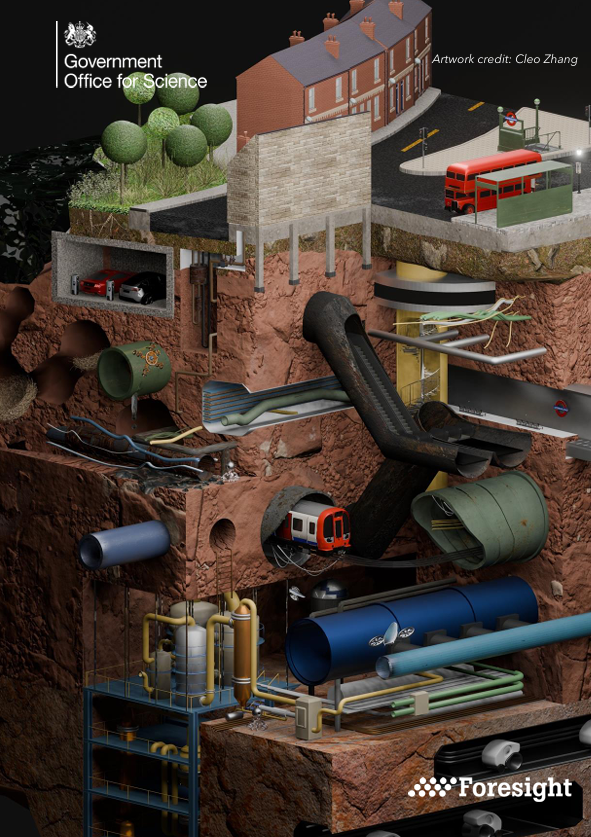
Subsurface Data: New foresight report from the UK Government Office for Science. The subsurface is a space much the same as the above ground whose use needs to be monitored, planned, and managed. But the data, technologies, and policy tools needed for this lag behind those available for the surface.
Quotes on data include: “Evidence gathered for this project suggests that moving to a three-dimensional planning approach that manages how space is used vertically as well as horizontally would be a major step towards parity between the subsurface and the surface.” Improving data availability, accessibility and quality is a key challenge.”
“Progress has been made in collection of data on geology and subsurface infrastructure, but improving the quality and granularity of this data would make it more useful for informing decisions. This is also true for other subsurface features where data is not comprehensively collected, such as groundwater.”
“The subsurface today houses different assets and services required for everyday life. These include water supply, sewers, energy, waste storage, building foundations and transportation, as well as resources like minerals and aggregates that are essential to our economy.”
“With the demand for these set to increase, pressures on the subsurface are likely to grow over the coming decades. The subsurface will play an increasingly vital role in reaching our net zero ambitions, in how we adapt to climate change, and in how we grasp the opportunities presented by technological innovation. As these needs drive competition for space, there is a risk that congestion could limit our options for how we use it in the future.”
“Stakeholders we spoke to during this project emphasised the importance of an improved knowledge and understanding of the subsurface to address a range of challenges. This relates to both improved collection of and access to data, and to analytical insight into connections within the subsurface (e.g. via qualitative systems maps or in quantitative models).”
“A greater focus on directing technological developments towards addressing cross cutting subsurface challenges was also found to be critical. In particular, new technologies are likely to help with:
– reducing the cost and improving the quality of data collection and use (supported by quantum sensors, fibre options, muography, AI, digital twins)
– reducing the cost and disruption of excavation, construction, and maintenance of subsurface assets (supported by VR/AR, robotics/drones..)”
Excellent work from the GO-Science team to facilitate this, led by Holger Kessler. I was pleased to provide my small input into the report. Hopefully this will trigger a step change in how we approach the holistic management of data on the UK’s subsurface asset for industry and societal benefit.
Report here: https://assets.publishing.service.gov.uk/media/66fd3c52e84ae1fd8592ecb1/Foresight_Future_of_the_Subsurface_report.pdf
 A Geodyssey - Geoscience Text Analytics and Enterprise Search Research
Leave a comment