
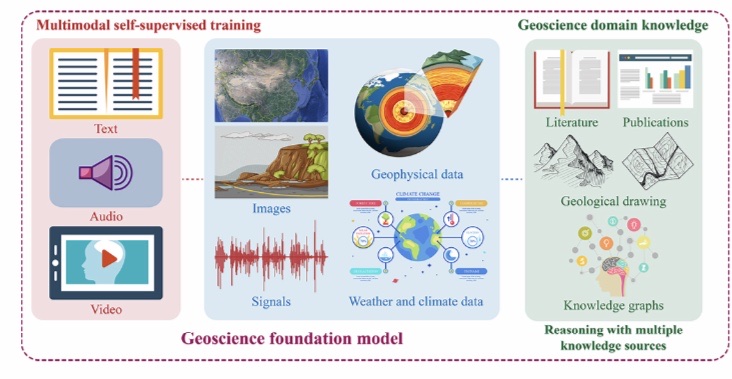
Interesting article from Zhang and Xu (2023) postulating what geoscience language models may become. Multi-disciplinary, Multi-modal inputs and outputs. They state Language Model’s capability for scenario planning and qualifying uncertainty mean it could be a critical tool to address important issues such as climate change, natural hazards and sustainable development of natural resources.
They describe the potential of data centric AI is to uncover hidden insights but highlight many challenges will need to be overcome (verifying data, scalability, knowledge representation and social biases).
Link to paper: https://arxiv.org/pdf/2309.06799v1.pdf
“By leveraging techniques like self- supervised learning, the geoscience foundation models undergo training using multimodal and multidimensional geoscience data models. For enhanced versatility, the data schema can be coupled with language inputs, such as text, voice, or video data. Furthermore, the geoscience foundation models require access to diverse sources of geoscientific knowledge to facilitate geoscientific inference tasks, unlocking a plethora of functionalities applicable to downstream applications. Once trained, the geoscience foundation models can dynamically perform user- specified tasks in real-time. To accomplish this, the model can retrieve contextual information from geological mapping manuscripts, knowledge graphs, databases, and other relevant sources, capitalizing on formal geoscience knowledge to deduce solutions for previously unseen tasks.”
 A Geodyssey - Geoscience Text Analytics and Enterprise Search Research
Leave a comment