
 Some new research published on geoscience text analytics.
Research driven from China and Canada. Predominant focus on mining, using vectorspace and knowledge graphs on automatically extracted entities and concepts. Looking at associations to predict new deposits.
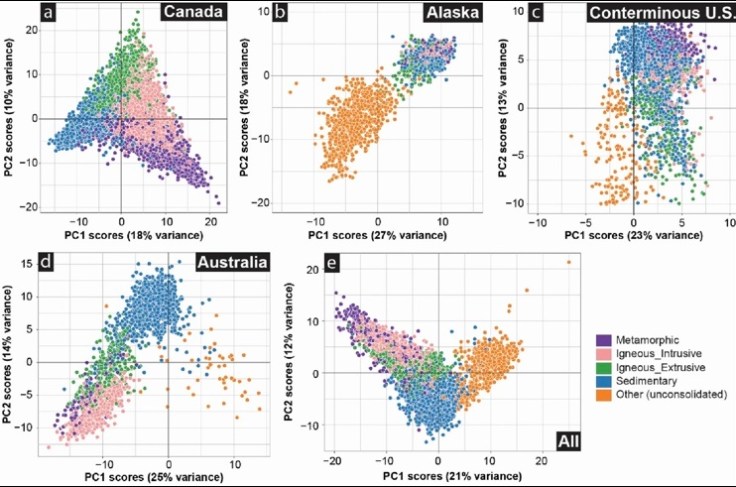
Lawley et al (2023). Applications of Natural Language Processing to Geoscience Text Data and Prospectivity Modeling. Natural Resources Research.
https://link.springer.com/article/10.1007/s11053-023-10216-1
Very interesting read, uses word vector similarity in text for associated lithology names to predict pegmatites rocks, Mississippi Valley Type Lead Zinc deposits and analogues.
Qiu et al (2023) Construction and application of a knowledge graph for iron deposits using text mining analytics and a deep learning algorithm. Mathematical Geosciences 55, p423-456
https://link.springer.com/article/10.1007/s11004-023-10054-0
Ore forming geological conditions were extracted from under utilised exploration reports.
Qiu et al (2023). Geological profile text information association model of mineral exploration reports for fast analysis of geological content. Ore Geology Reviews 153.
https://www.sciencedirect.com/science/article/pii/S0169136822005868
Using knowledge graphs on extracted entities and concepts from text.
Ma et al (2022). Text visualisation for geological hazard documents via text mining and natural language processing. Earth Science Informatics 15(1) p1-16
Word clouds of extracted geological terms.
Zhang et al (2023). GeoDeepShovel: A platform for building scientific database from geoscience literature with AI assistance. Geoscience Data Journal.
https://rmets.onlinelibrary.wiley.com/doi/full/10.1002/gdj3.186
PDF extraction tools as part of Deep Time Digital Earth (DDE) program specifically for data in tables, maps and images.
 A Geodyssey - Geoscience Text Analytics and Enterprise Search Research
Leave a comment