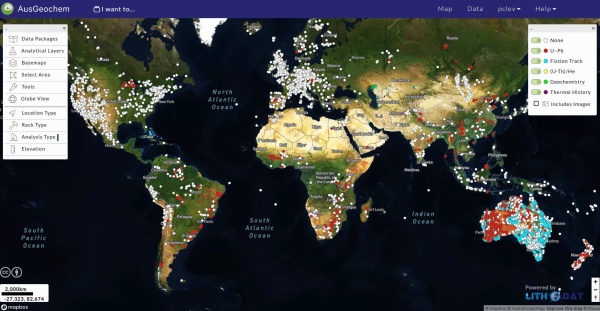
Open Geochemical Data Platform

An Open Platform for Geochemical Data Preservation, Dissemination and Synthesis. I came accoss this open data platform recently. A group of Australian university research laboratories (AuScope Geochemistry Network) built a collaborative platform to collate, preserve and disseminate geochronology and isotopic data. https://ausgeochem.auscope. Boone, S.C., Dalton, H., Prent, A., Kohlmann, F., Theile, M., Gréau, Y., Florin,... Continue Reading →

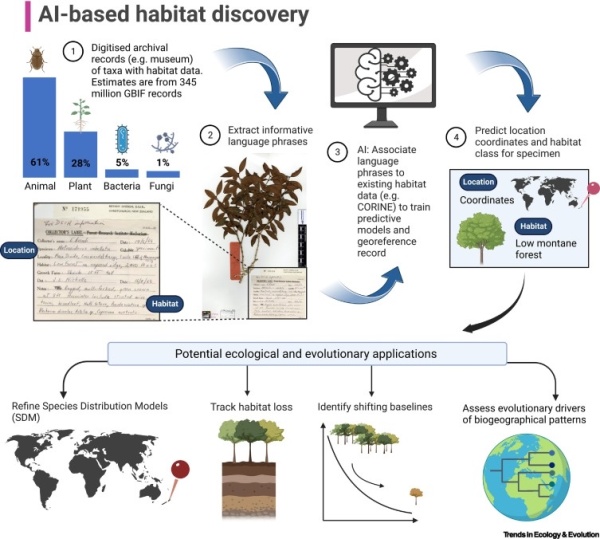
AI based discovery of habitat from museum archive documents using Natural Language Processing (NLP)

Interesting paper published by Jones et al (2024) on applying Optical Character Recognition (OCR) and NLP to hand written archives. Some descriptions date to the 18th century with over 2 Billion records in the Global Biodiversity Information Facility (GBIF), including habitat information related to geographical location, land cover, hydrological, soil and bedrock. "Habitat data can... Continue Reading →

Ethical use of Artificial Intelligence

The European Geosciences Union (EGU) has recently released guidelines for the use of AI-based tools in the publication process. This is to help ensure the ethical use of AI tools in the rapidly evolving landscape of scholarly communication. https://www.egu.eu/news/1031/statement-on-the-use-of-ai-based-tools-for-the-presentation-and-publication-of-research-results-in-earth-planetary-and-space-science/ The American Geophysical Union (AGU) published their guidelines for ethical use of AI last year: https://news.agu.org/press-release/agu-publishes-guidelines-for-the-ethical-use-of-ai-in-the-earth-and-space-sciences/ Rivas... Continue Reading →

Prime Minister at No 10

I met the Prime Minister today at No 10. Interesting to discuss various topics with those present. I discussed the importance of geoscience, the subsurface, artificial intelligence and data management.

AI, Language Models and Disaster Risk Reduction

Photo credit: Image by Mikhail Nilov from Pexels (Pexels licence) I came across an interesting blog from the European Geosciences Union (EGU) by Paulo Hader. Link to blog here: https://blogs.egu.eu/divisions/nh/2024/02/05/new-era-of-ai-how-can-foundation-models-help-disaster-risk-reduction/ Paulo suggests how Foundation Large Language models (LLM) can be incorporated into approaches for disaster risk reduction. "While traditional machine learning models are limited in... Continue Reading →

Fossil preparation

It's nice to step away from the computer and do some fossil preparation! I'm using compressed air which is funneled through a 'pen' removing the rock matrix to reveal the fossil. In this case an ammonite (bottom right) from the Jurassic, collected at Charmouth beach in Dorset, England.  It looks like a few pieces of... Continue Reading →

Geoscience meets Generative AI

When Geoscience Meets Generative AI and Large Language Models: Foundations, Trends, and Future Challenges. I found this recent paper by Hadid et al (2024) helped spark a few ideas for me on how we may apply large Language Models (LLM) to real world problems which include geological information and related disciplines. Explainability and trustworthiness of... Continue Reading →

GeoNLU Natural Language Understanding and Spatial Data Infrastructure

GeoNLU: Natural Language Processing (NLP) and Spatial Data Infrastructure. Combining NLP, Natural Language Understanding (NLU) and Spatial data is important to many sectors. An interesting paper was published by Naveen et al (2024) recently that covers this space specifically focused on querying spatial data using natural language. The abstract states: "Integrating natural language processing (NLP) techniques with... Continue Reading →

Website Powered by WordPress.com.

Up ↑